
 Image 1 of 1
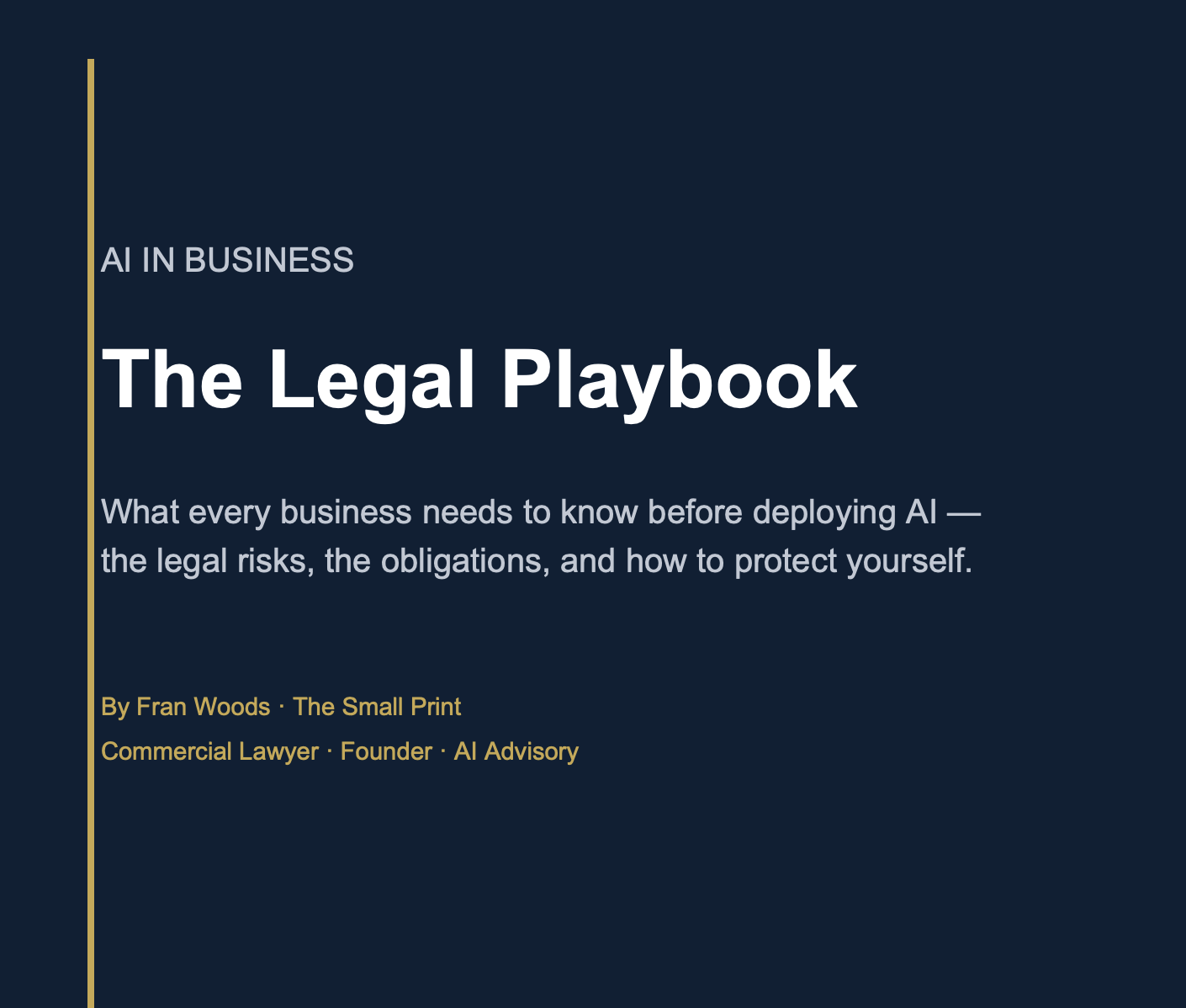
AI in Business — The Legal Playbook
Most businesses are using AI tools without understanding the legal exposure they're creating.
Not because they're careless. Because the legal conversation hasn't kept up with how fast these tools have moved into everyday business operations.
This playbook closes that gap.
Written by Fran Woods — commercial lawyer, AI advisory specialist, and founder — AI in Business: The Legal Playbook is a plain-English guide to the legal considerations that apply when your business uses AI. No jargon. No scare tactics. Just the things you actually need to know, and what to do about them.
What's inside
01 — What AI tools are actually doing with your data Where your data goes, whether it's being used to train AI models, how to opt out, and what cross-border data flows mean for your legal obligations.
02 — Intellectual property Who owns content created with AI, the copyright risks in AI-generated output, and how to protect what you create.
03 — Contracts and liability What your client agreements should say about AI use, what your vendor agreements with AI providers actually say, and where your liability exposure sits.
04 — Privacy law and customer data How privacy obligations apply when AI touches personal information, what your privacy policy needs to say, and what's changing under proposed reforms.
05 — Employment and workplace Using AI to manage or assess people, the employee AI use policy most businesses are missing, and disclosure obligations in hiring.
06 — Sector-specific risks Additional obligations for financial services, healthcare, legal and other regulated industries — plus consumer law considerations for customer-facing AI.
07 — The Master Checklist A practical checklist covering what to do before you deploy any AI tool, your ongoing obligations, and when to get a lawyer involved.
Who this is for
→ Business owners and operators using AI tools in their day-to-day work → Founders deploying AI as part of their product or service → Marketing, operations and HR teams who need to understand the guardrails → Anyone who has signed up to an AI tool and never read the terms
Who this isn't for
This is not a technical guide to implementing AI, and it's not legal advice specific to your circumstances. It's the foundational legal knowledge that lets you make informed decisions — and know when you need more.
About the author
Fran Woods is a commercial lawyer with 19 years of experience across in-house and independent practice. She has founded three companies, advised premium consumer brands and high-growth businesses across Australia and New Zealand, and now runs a dedicated AI legal advisory practice through The Small Print.
This playbook draws on that experience — not on a general survey of what AI might mean for law, but on the specific questions that actually come up when businesses use these tools in practice.
Instant digital download · PDF format · 2026 edition
Delivered immediately to your inbox on purchase. Applicable to businesses operating in Australia and New Zealand.
This playbook is for general educational purposes and does not constitute legal advice.
Most businesses are using AI tools without understanding the legal exposure they're creating.
Not because they're careless. Because the legal conversation hasn't kept up with how fast these tools have moved into everyday business operations.
This playbook closes that gap.
Written by Fran Woods — commercial lawyer, AI advisory specialist, and founder — AI in Business: The Legal Playbook is a plain-English guide to the legal considerations that apply when your business uses AI. No jargon. No scare tactics. Just the things you actually need to know, and what to do about them.
What's inside
01 — What AI tools are actually doing with your data Where your data goes, whether it's being used to train AI models, how to opt out, and what cross-border data flows mean for your legal obligations.
02 — Intellectual property Who owns content created with AI, the copyright risks in AI-generated output, and how to protect what you create.
03 — Contracts and liability What your client agreements should say about AI use, what your vendor agreements with AI providers actually say, and where your liability exposure sits.
04 — Privacy law and customer data How privacy obligations apply when AI touches personal information, what your privacy policy needs to say, and what's changing under proposed reforms.
05 — Employment and workplace Using AI to manage or assess people, the employee AI use policy most businesses are missing, and disclosure obligations in hiring.
06 — Sector-specific risks Additional obligations for financial services, healthcare, legal and other regulated industries — plus consumer law considerations for customer-facing AI.
07 — The Master Checklist A practical checklist covering what to do before you deploy any AI tool, your ongoing obligations, and when to get a lawyer involved.
Who this is for
→ Business owners and operators using AI tools in their day-to-day work → Founders deploying AI as part of their product or service → Marketing, operations and HR teams who need to understand the guardrails → Anyone who has signed up to an AI tool and never read the terms
Who this isn't for
This is not a technical guide to implementing AI, and it's not legal advice specific to your circumstances. It's the foundational legal knowledge that lets you make informed decisions — and know when you need more.
About the author
Fran Woods is a commercial lawyer with 19 years of experience across in-house and independent practice. She has founded three companies, advised premium consumer brands and high-growth businesses across Australia and New Zealand, and now runs a dedicated AI legal advisory practice through The Small Print.
This playbook draws on that experience — not on a general survey of what AI might mean for law, but on the specific questions that actually come up when businesses use these tools in practice.
Instant digital download · PDF format · 2026 edition
Delivered immediately to your inbox on purchase. Applicable to businesses operating in Australia and New Zealand.
This playbook is for general educational purposes and does not constitute legal advice.